Audit
Screenshots use fictional demo accounts and fixed example metrics, not live systems or qualification evidence.
The owner can Search audit log across the person (actor), action name, target and stored details. Search runs on the server after a short pause while typing, combines with Type, Person and Since, and treats punctuation literally. The page shows how many entries it received before repeated terminal reads are folded; it does not count the entire matching history. More available means there is another page. Previous and Next use stable entry cursors, 100 entries at a time; newly arriving events do not shift forward pages. Changing a filter returns to the newest matching entries. Search is limited to 256 characters and has a database time/work budget. If it reaches that limit, narrow Type, Person or Since and retry; an interrupted search does not claim there are no matches. Access remains owner-only.
Every change made through Rynhult is recorded: who, what and when. That covers sign-ins, sessions created, stopped and renamed, trust, publishing decisions, catalog changes, repository creation and promotions.
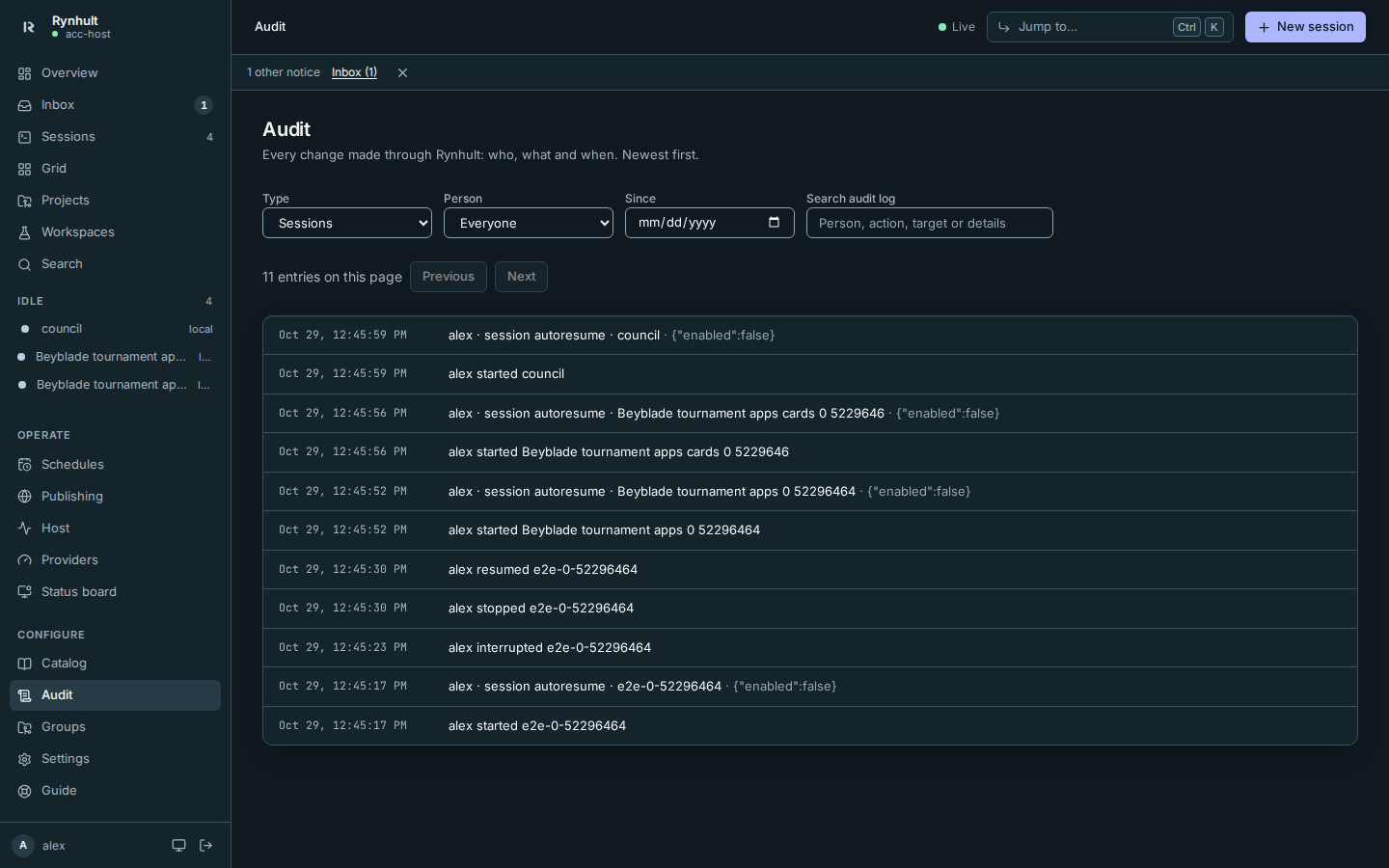
Each entry reads as a sentence, for example alex opened api-refactor's terminal to type or alex trusted demo-api. Hover an entry for its exact action name and details. Just looking at a session opens its terminal, so those entries fold into one per person, session and day (· 4 times that day); so do text snapshots of a terminal (alex read api-refactor's terminal output as text). Secrets are never recorded.
Filter by Type (Sessions, Terminals, Projects, Publishing, Sign-in…), by Person (or Rynhult (automatic) for what Rynhult did by itself) and from a day with Since.
For Orchestrator teams, choose the type Orchestrator teams to see team.grant, team.start, team.message, team.merge, team.stop, team.finish and team.expired. Agent decisions identify the calling session; grants identify the person who gave the role.
For Multi-run, choose Several agents:
multirun.start records the chosen launch combinations (not the task text);
multirun.keep records the winner and whether archiving the others was requested.
Each run also has its normal launch, dangerous-mode confirmation and lifecycle
audit entries.
Local Git identity saves use git.identity.update, targeting the person's account
without copying their name or email into the log. Push subscription creation uses
push.subscribe; key rotations, ownership changes and failure-counter resets use
push.update. Identical re-subscriptions add no event. Push events target the
device's numeric id; update details say whether ownership or keys changed, without
recording endpoints or keys. The change and its audit entry commit together.
This page is generated from docs/wiki/User-Guide/Audit.md; the same page is under Guide inside Rynhult.